Virtual Seminar recorded on Zoom, 18th of November 2020.
Speaker: Lina Eklund, Department of Informatics and Media
Lina Eklund is a lecturer in Human Computer Interaction at the Department of Informatics and Media, Uppsala University. Lina’s research focuses on the intersections between technology as a designed structure affording behaviour and the agency of users to reformulate those affordances. Her current work concerns the role of digital games and hybrid technology for visitor experiences in museums. This presentation presents the results of a recently finished four year research project hosted at the National Museum for Technology and Engineering in Stockholm, Sweden. The project “Worlds of Computer Games” focused on the role of digital games in museums. Recent attention to the question of preservation and exhibition of video games in cultural institutions such as museums indicates that this media form is moving from being seen as contentious consumer object to cultural heritage. This empirical study examines two recent museum exhibitions of digital games: GameOn 2.0 at the National Museum of Science and Technology in Stockholm (TM), and Women in Game Development at the Museum of Art and Digital Entertainment, Oakland (MADE). The study explores how games are appropriated within such institutions, and thereby how they are configured as cultural heritage and exhibitable culture. The study uses actor-network theory in order to analyse heterogeneous actors working in conjunction in such processes, specifically focusing on translation of games and game culture as they are repositioned within museums. The study explores how games are selectively recruited at both institutions and thereby translated in order to fit exhibition networks, in both cases leading to a glossing over of contentious issues in games and game culture. In turn, this has led to a more palatable but less nuanced transformation of video games into cultural heritage. While translating video games into cultural heritage, the process of making games exhibitable lost track of games as culture by focusing on physical artefacts and interactive, playable fun. It also lost track of them as situated in our culture by skimming over or ignoring the current contentious nature of digital games, and finally, it lost track of games as being produced and experienced in a particular context, or games of culture.
Virtual Seminar recorded on Zoom, 4th of November 2020.
Title: Censuses of Gustavia 1835-1872: Digital Mapping of Diversity and Division in the Swedish Caribbean
Speaker: Ale Pålsson, Department of History
In recent years, renewed interest in the Swedish-Caribbean colony of St Barthélemy has sparked new research, as well as digitalization efforts to organize and make accessible the Swedish colonial archives via the SWECARCOL project. As a member of this project, I have reviewed censuses of the main city of the colony Gustavia, and recreated a graphical representation of the censuses via digital mapping. By examining both the changing dimensions of the city, as well as the changing categorizations, we can illustrate how Caribbean cities evolved during this formative period, as the colony moved from being part a slave society, to emancipation of the enslaved and an end of racial categorization.
Benjamin G. Martin, Department of History of Science and Ideas, Uppsala University
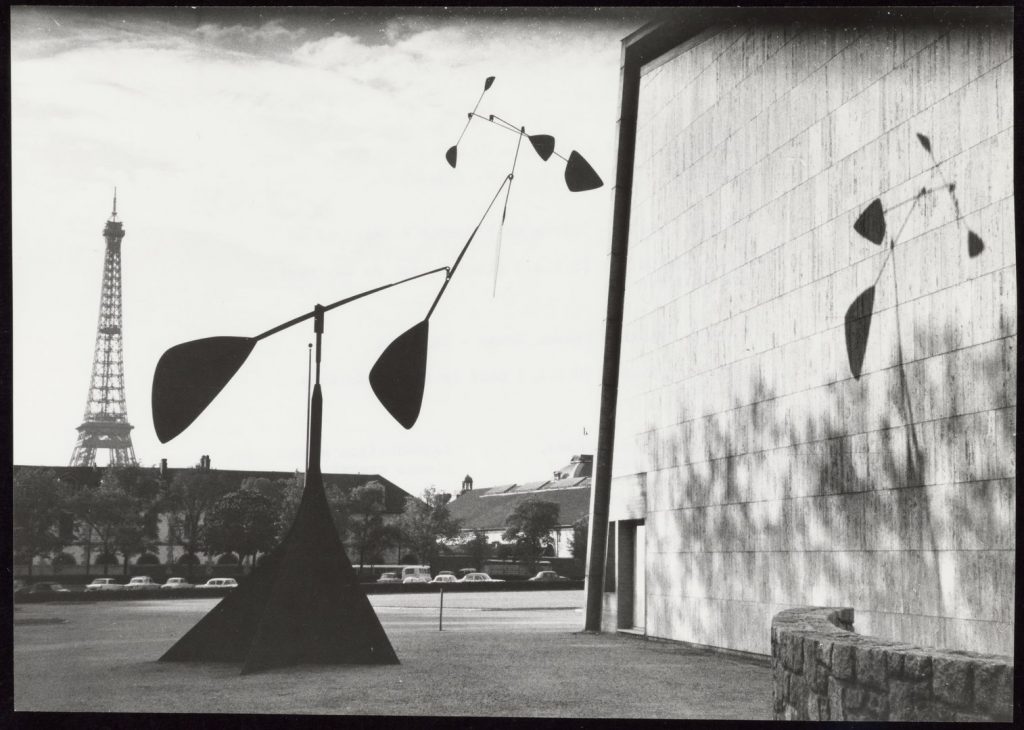
Alexander Calder’s sculpture “Spirale” (1958) at UNESCO headquarters in Paris. Photo credit: UNESCO / H. D. Berendt.
Recent years have seen a burst of interest in “global intellectual history.” Practitioners debate the precise meaning of this phrase, but it evidently reflects an ambition to take a more inclusive approach to the history of ideas around the world—beyond the Western European core on which the field has traditionally focused—paying attention in particular to the cross-cultural contacts that are so important to our globalized present. [1] The last decade or so has also witnessed growing interest in what could be called digital intellectual history. This trend is characterized by the application of tools and methods from the digital humanities to approach questions in the history of science and ideas. Intellectual history’s digital turn is less well established than its global one, but it seems likely to continue and to grow in scale. [2]
These two trends in intellectual history -— the global and the digital —- seem to have a lot to offer one another. But so far they have developed as it were on parallel tracks: both moving forward but with little contact between them. There are several reasons for this. But one particular challenge to using digital methods as part of a global approach to intellectual history has to do with sources. Locating historical source materials that give us access to a “global” realm is hard enough by itself. Few scholars can handle more than a few languages, and studies of the transnational movement and reception of ideas have often tended “simply to multiply the frame of national history.” [3] Locating sources that are global and amenable to digital analysis is harder still. Most of the big text repositories that intellectual historians have used -— like Eighteenth-Century Collections Online, used in the historian Peter De Bolla’s recent book The Architecture of Concepts —- are national in character. [4] Newspapers, another source in which to follow language use and, perhaps, concept development over time, are likewise almost always national. Moreover, the historical sources that get digitized have so far tended to be from wealthy countries in the global north, with their large, well-financed libraries and expensive digitalization facilities. So far, then, an intellectual historian’s effort to go digital would appear to be at odds with the aspiration to go global.
There is, however, one major arena in which, for the last half-century or so, representatives of nearly every country on earth have regularly met and interacted, and about which a growing mass of digitized historical source materials is available: the world of international organizations. As the historian Sandrine Kott has observed, bodies like the United Nations, the World Health Organization, or the International Olympic Committee can be studied not only as actors in their own right, but as “open social spaces through which we can observe exchanges and circulation” —- including exchanges and circulation of ideas.[5]
This is the point of departure for the research project International Ideas at UNESCO. In this study, researchers and systems developers at Uppsala University and at Humlab (the digital humanities center at Umeå University) apply cutting-edge tools of digital text analysis to a selection of texts produced by this international organization. Founded in 1945 to promote “peace in the minds of men,” UNESCO has debated and acted on matters of particular interest to intellectual historians: the organization and dissemination of knowledge, the role of cultural expression in human communities, and the power of communication across national, ideological and cultural boundaries. Since the early 1960s, when the organization was joined by many newly independent post-colonial states, it has handled these matters as a truly global forum. In recent years, the organization has undertaken an ambitious digitalization project, rendering large quantities of its publications and archival documentation available to the public. In fact, many of these texts still require a good bit of curating before they can be analyzed with digital methods; that curating is what we are working on now! As we move forward, our hope is that new methods of digital text analysis, sophisticated enough to chart conceptual relations and development, will offer exciting ways to explore the global discourse captured in these sources.
Can intellectual history’s digital and global turns be brought together in a way that benefits both? At its most ambitious, International Ideas at UNESCO is an effort to find out.
[1] See for example Samuel Moyn and Andrew Sartori, eds., Global Intellectual History (New York: Columbia University Press, 2013); and the journal Global Intellectual History. [2] See the discussion of this trend in: Dan Edelstein, “Intellectual History and Digital Humanities”, Modern Intellectual History 13, 1 (2016): 237-246; Mark J. Hill, “Invisible Interpretations: Reflections on the Digital Humanities and Intellectual History”, Global Intellectual History 1, 2 (2016): 130-150; and Jennifer London, “Re-imagining the Cambridge School in the Age of Digital Humanities”, Annual Review of Political Science 19, 1 (2016): 351-373. [3] Christopher L. Hill, “Conceptual Universalization in the Transnational Nineteenth Century”, in S. Moyn and A. Sartori, eds., Global Intellectual History (New York: Columbia University Press, 2013), 135. [4] Peter De Bolla, The Architecture of Concepts: The Historical Formation of Human Rights (New York: Fordham University Press, 2013). [5] https://zeithistorische-forschungen.de/3-2011/4563
About the DH blog
An outlet for new ideas, research presentations and other outputs from the Digital Humanities Uppsala research network.

Recent Comments