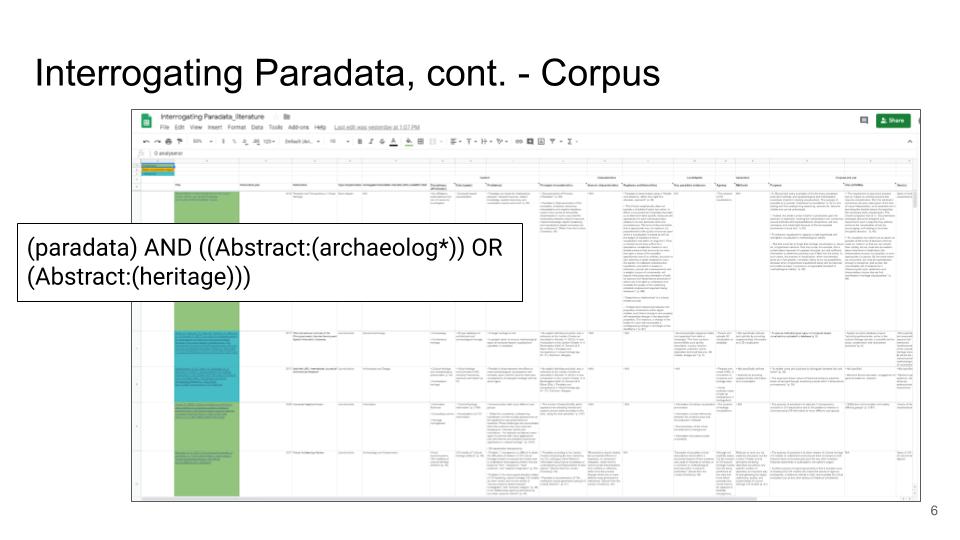
Although the mantra of the CAPTURE project staff is that we’re curious about everything that could possibly count as information about data production and management processes, the researchers and professionals we meet have a different interest: What is paradata? And can you tell us how it relates to metadata? Most are less than satisfied with our indeterminate answers which are based on our mapping of the multiple meanings and usages of the term in archaeology and cultural heritage (forthcoming paper): paradata is a useful but also slippery notion that serves an array of purposes. Disappointing as our analytical take on the term may be for the ones who could have used a more clear-cut definition like yesterday, the interest in the term stimulates our continued work.
In terms of research, two of the project’s
larger data collection campaigns are at early stages. Firstly, we’re
interviewing both makers and users of research data to better understand the
production and use of information that detail data-production processes
(‘paradata’) . Tips of possible informants, that is researchers with repeated
experiences of depositing data and researchers with experiences of recurring
analytical reuse of research data, are warmly welcome. Secondly, we’re
designing a survey of paradata practices that will be open for respondents
during fall 2020.
CAPTURE will invite participants
to a full day of presentations and discussions about process information in
archaeology at Uppsala University Monday April 20th 2020. Please contact us if
you’re interested in joining this event!
This project is funded by the European Research
Council (ERC) under the European Union’s Horizon 2020 research and innovation
programme grant agreement No 818210.
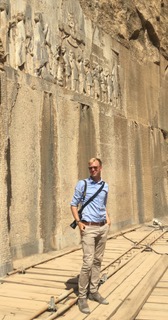
Below the 5th century BCE inscription of Darius the Great at Bīsutūn, Iran, in August 2018
I started out as an Assyriologist*, specializing in the world of cuneiform, a script in broad use across much of the Middle East from c. 3,300 BC until c. 100 AD. Not too many are studying it, and relatively few of that exclusive lot were doing much with a computer. Later, for my doctorate, I ventured into landscape archaeology, a field which had next to nothing to do with cuneiform, something my doctoral supervisor gently pointed out to me when he said that I had committed quite a career suicide by coming over. At least in the short term. For the first year, I locked myself into a basement trying to learn the basics of GIS and remote sensing, with a whole bunch of nerds who knew nothing whatsoever about cuneiform, but very much about exotic abbreviations such as GPS, GCPs, CRS, LIDAR, UAV, and DEMs, and compound curiosities like georectification, least-cost-pathways, viewscapes, panchromatic, and shapefile. I found myself constantly returning to my supervisor’s office half a day after each meeting we had, to say that we fundamentally misunderstood each other concerning whatever interface between philology and landscape archaeology we had last discussed.
Gradually,
however, I also realized that each of those meetings produced something
genuinely new because, being so wildly unfamiliar with common knowledge in each
other’s fields, we constantly found ourselves asking new questions, addressing
new issues, seeing new perspectives in matter otherwise all told and accounted
for. A lot of this came straight out of the elementary yet stimulating
challenge of how to integrate data and knowledge from very different fields of
research within a common frame. And that’s what I found so immensely
fascinating about digital fora in an academic setting, then and now. That subtle
ability of a shared methodological or technical forum to bring different
perspectives, different minds, different disciplines together, oftentimes for
purposes that were rarely immediately clear to anyone involved. Thus, my
doctoral dissertation came to deal with a very novel combination of
quantitative approaches to data contained in a couple of thousand
administrative texts – and settlement patterns as derived from spatial data
sets that the nerds in the basement had been playing around with for years. The
core argument was that, when properly scaled within a formal and coherent
analytical frame, ancient texts could indeed be brought to bear on conclusions
derived from satellite imagery and site mapping at a regional level. In my case
casting some decent, and empirically solid, light on the material size of early
state economies.
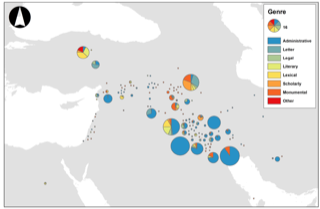
Draft distribution map of close to 250,000 cuneiform texts ordered by genre from c. 200 archaeological locations across the Middle East
My current work at Uppsala University, and my engagement with Digital Humanities Uppsala, is very much a result of those early exposures to very different ways of studying and approaching the past. Our brand-new research project at Assyriology, funded by Riksbankens Jubileumsfond and called Geomapping Landscapes of Writing, or GLoW for short, aims to trace the distributional and compositional outlines of a discrete historical record, namely the cuneiform corpus, in its entirety. Counting perhaps half a million known texts, spanning a temporal transect of some 3,000 years, and traversing a geographical area reaching from the central Mediterranean to the eastern deserts of Iran, this corpus offers an opportunity to study the role of writing in early human history, its material distribution and composition, from a birds-eye perspective. Such an undertaking would have been unthinkable a decade ago, and its methodology owes as much to landscape archaeology as it does to cuneiform studies. Related ideas underpin the research network TextWorlds: Global Mapping of Texts from the Pre-Modern World, another new initiative that I am involved in, funded by CIRCUS, which will bring together philologists, archaeologists, and historians from across the university to discuss and explore shared traits between written corpora from around the world. A crucial basis for such initiatives is the ability to work from a shared, read digital, methodological platform able to capture vast amounts of data from seemingly disparate disciplines, each with their own way of approaching and studying the past, and oversee it within a shared frame of scholarly inquiry. So, over the next three years, I am looking forward to spending even more time lingering over applications, programs, and code with researchers from across the humanities and social sciences, debating, experimenting, and discovering new ways of fusing together our various specialties. From past experience, I would say that fora like Digital Humanities Uppsala are perfect for that sort of activity.
* Don’t worry if you don’t know what that is. Back in the pre-digital age, one of my teachers had been enrolled at Psychology for most of his undergraduate years because the university administration didn’t know either.
Maureen Ikhianosen Onwugbonu and Aikaterini Charalampopoulou, students at the DH Master’s Programme, recently published reports on their internships at Museum Gustavianium.
Är du forskare eller museiintendent och vill få bättre förståelse för hur forskning kan berika ett museums digitala samling? I sådana fall får du inte missa Riksantikvarieämbetets och Digital Humaniora Uppsala universitets workshop den 10-12 juni.
Workshoppen kommer innehålla inspirerande exempel, praktiska råd och inte minst grupparbeten där forskare och museipersonal får möjlighet att tillsammans diskutera de utmaningar och behov som finns. Fokus kommer att ligga på att öka forskarens förmåga att hitta och att använda digital samlingsinformation samt att visa på hur forskningsresultatet även kan återanvändas och bli till nytta för samlingsförvaltarna.
Workshoppen arrangeras av Riksantikvarieämbetet och Digital Humaniora Uppsala universitet med stöd av Europeana och vänder sig till dig som är forskare eller museiintendent.
Anmälan öppnar senare i vår – på den här sidan kommer vi löpande lägga upp senaste nytt om workshoppen.
Recent Comments